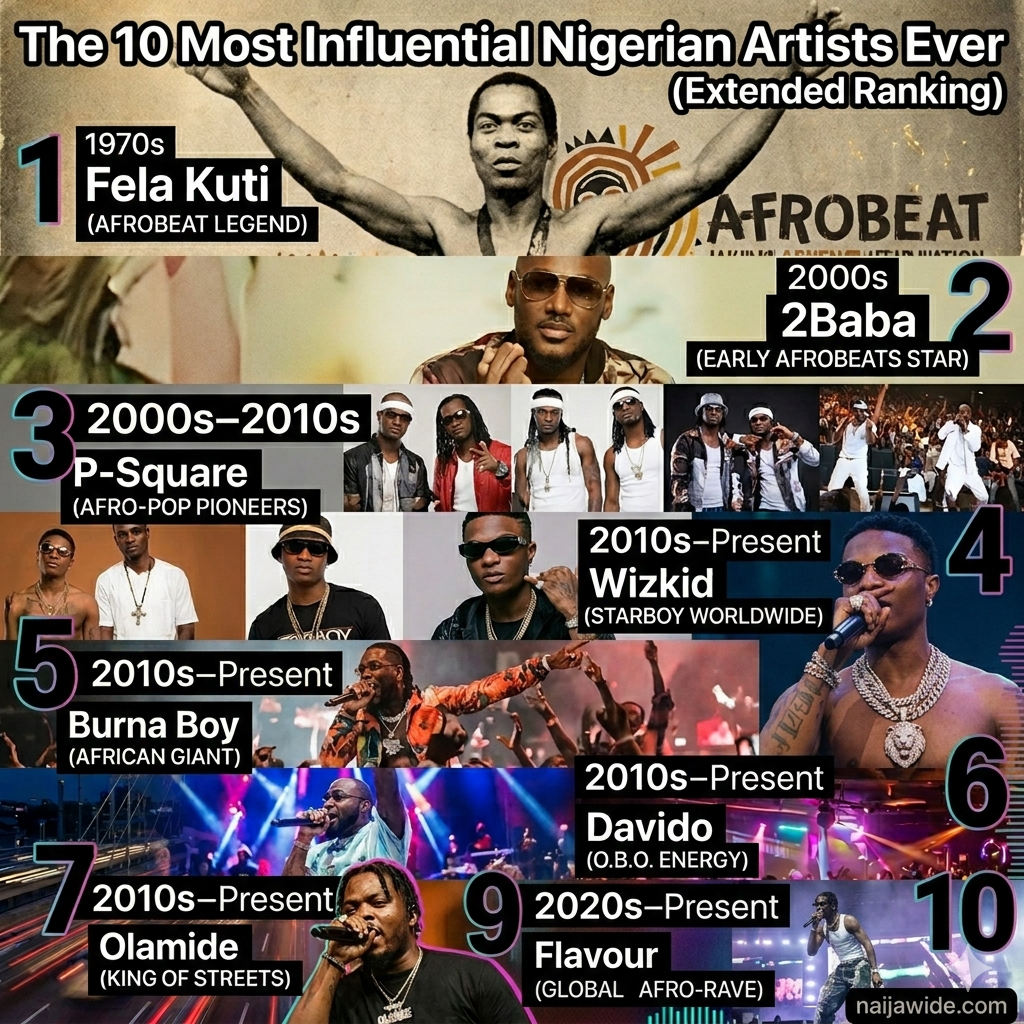
Few countries shape global music culture like Nigeria.
From the revolutionary Afrobeat movement created by Fela Kuti to today’s billion-stream Afrobeats era led by Wizkid, Burna Boy, Davido, and other global stars, Nigerian artists have transformed local sounds into one of the biggest musical exports in the world.
But influence is bigger than hit songs.
Influence means changing culture, opening doors internationally, inspiring new generations, building movements, and creating sounds that survive beyond trends.
As Afrobeats continues dominating globally in 2026, debates around the most influential Nigerian artists ever have become louder across X, TikTok, streaming conversations, and entertainment media.
Some names are almost untouchable historically. Others represent the global expansion era. And newer stars are beginning to build their own legacies in real time.
Here are the Nigerian artists whose impact changed music culture permanently.
-
Fela Kuti
No serious Nigerian music conversation starts anywhere else.
Fela Kuti remains the foundation of modern African music influence globally. The Afrobeat pioneer did not only create a genre, he created a cultural and political movement that still shapes artists decades later.
His music fused jazz, funk, highlife, and African percussion into a revolutionary sound that challenged political oppression and social injustice openly.
Even in 2026, his influence remains active.
Renewed conversations around his legacy resurfaced recently following continued international recognition, including renewed global attention around his Rock & Roll Hall of Fame influence narrative. Nigerian fans consistently describe him as “the root” of everything that came after.
Without Fela, modern Afrobeats likely looks completely different.
-
2Baba
Before Afrobeats became a global business, 2Baba created one of Nigeria’s first truly pan-African crossover records.
African Queen changed everything.
Released in 2004, the song became a cultural landmark across Africa and introduced millions of international listeners to modern Nigerian pop music before streaming platforms fully existed.
Beyond the music, 2Baba’s consistency, humility, activism, and longevity helped establish what a respected Nigerian music legend could look like.
Many younger artists still reference him as one of the artists who made the current industry structure possible.
For older Nigerian music fans especially, his influence remains untouchable.
-
Wizkid
When conversations shift toward global Afrobeats expansion, Wizkid’s name dominates almost every debate.
From early hits like Holla At Your Boy to international breakthroughs alongside Drake on One Dance and later Essence, Wizkid helped move Afrobeats from regional success into mainstream global pop culture.
For many fans, he represents the artist who opened the biggest international doors for Nigerian music commercially.
Streaming numbers support the argument too.
Wizkid remains one of Africa’s most streamed artists ever, while Essence became one of the defining crossover Afrobeats records globally.
His calm delivery, minimalistic style, and ability to make Nigerian sounds feel internationally accessible changed the entire industry blueprint.
Even artists within the industry openly acknowledge his impact.
-
Burna Boy
Burna Boy’s influence comes from scale, artistry, and cultural depth.
While many artists chased international validation through pop collaborations, Burna built his identity around African pride, live instrumentation, activism, and genre fusion.
His Grammy success elevated Nigerian music conversations globally, while sold-out arena tours proved Afrobeats could dominate major world stages without losing cultural authenticity.
Fans also connect Burna Boy directly to Fela’s legacy because of his socially conscious themes and Afro-fusion experimentation.
In 2026, conversations around his influence remain strong following major award recognition and continued global dominance.
For many listeners, Burna represents the artist who made “African giant” energy commercially viable worldwide.
-
Davido
Davido changed the commercial side of Nigerian music.
His consistency with hit records, collaborations, and audience engagement helped define modern Afrobeats accessibility. From club records to emotional anthems, Davido mastered the art of creating music that connects instantly with large audiences.
The rise of 30BG also showed how fan communities could become part of an artist’s long-term influence.
Even during periods when trends shifted heavily, Davido remained commercially relevant through sheer consistency and visibility.
Many fans see him as the artist who made mainstream Afrobeats feel larger than life socially.
-
Olamide
No artist shaped modern Nigerian street-pop culture more directly than Olamide.
Beyond his own success, his influence expanded through mentorship and artist development. Through YBNL, Olamide helped launch or elevate multiple stars who now dominate the industry, including Asake.
His ability to balance Yoruba rap, street identity, mainstream appeal, and business leadership made him one of the most respected figures in Nigerian entertainment.
In 2026, his influence conversations returned strongly again following the release of Rock Me Gentle and continued debates around the origins of today’s street-pop sound.
Many younger artists currently thriving commercially are operating within structures Olamide helped normalize culturally.
-
P-Square
Before streaming culture fully exploded, P-Square dominated Africa physically and culturally.
The duo transformed Nigerian pop performance standards through choreography, visuals, stage production, and crossover appeal across African countries.
For many millennials, P-Square represented the first Nigerian pop stars who genuinely looked and felt international at scale.
Their influence on African pop performance culture still appears in newer Afrobeats acts today.
The New Generation Is Building Legacy Fast
Artists like Asake, Rema, Tems, Ayra Starr, and Seyi Vibez are already entering influence conversations much earlier than previous generations.
Asake’s streaming dominance, Rema’s global crossover records, Tems’ international songwriting success, and Ayra Starr’s youth appeal all suggest the next era of Nigerian music influence is already forming.
Still, most fans believe influence takes time.
Streams alone are not enough.
Longevity, cultural impact, mentorship, innovation, and global relevance across years remain the biggest measurements in Nigerian music conversations.
Why These Debates Matter
Nigeria’s GOAT debates are bigger than fan wars.
They reflect how quickly Nigerian music has evolved globally.
Each generation solved different problems:
- Fela built the foundation
- 2Baba modernized crossover appeal
- P-Square commercialized African pop spectacle
- Wizkid globalized Afrobeats
- Burna expanded African identity worldwide
- Davido mastered mainstream consistency
- Olamide empowered street culture
Together, they created the ecosystem currently dominating global music conversations.
Final Thoughts
Ranking the most influential Nigerian artists will always remain subjective because influence means different things to different listeners.
Some fans prioritize global numbers. Others value cultural authenticity, activism, lyrical depth, or mentorship.
But one thing remains consistent across almost every conversation.
Nigerian music has become one of the world’s most powerful cultural exports because multiple generations of artists kept pushing the sound forward without abandoning their identity.
And in 2026, that legacy is still expanding.
Share On:
TAGS: 2Baba, Afrobeats, Burna Boy, Davido, Fela Kuti, GOAT Debate, Nigerian Music, Olamide, P-Square, Wizkid
CLICK HERE TO PROMOTE YOUR MUSIC/VIDEO